
Renogy vs LiTime: Which Lithium Battery for a Camper?
As an Amazon Associate I earn from qualifying purchases. Some links on this page earn us a small commission, at no extra cost to you. Full disclosure.
Renogy vs LiTime comes down to size, monitoring and the cold. The Renogy Core Mini is the smaller box and has no Bluetooth of its own. The LiTime Group 27 is the bigger box with an app built in. Both list 100 Ah, a 100 A BMS, IP65 and a 5-year warranty, and both stop charging below 32 F (0 C). We read both maker pages and both Amazon listings on 9 October 2026.

Quick answer
Checked on 9 October 2026. Choose the Renogy Core Mini if space is tight: Renogy lists 9.02 x 5.43 x 8.39 in, 21.8 lb and a 5000-cycle rating at 80% depth of discharge. Choose the LiTime Group 27 if you want Bluetooth monitoring in the battery itself and a standard Group 27 footprint. Neither charges below freezing unless you buy a self-heating version.
Both, with a buy button each
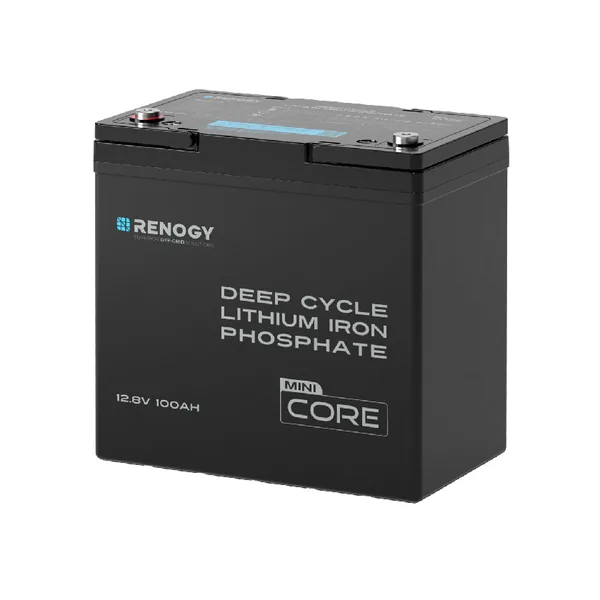
Renogy Core Mini 12V 100Ah
Lists 21.8 lb, IP65 and 5000 cycles at 80% depth of discharge. No Bluetooth in the battery. Read more
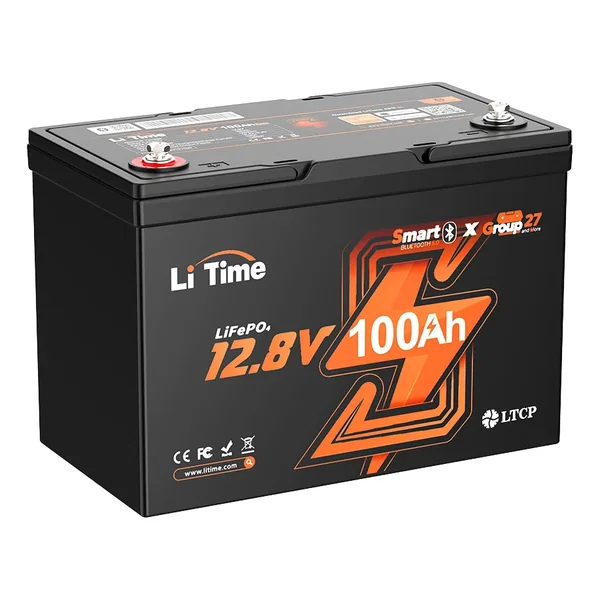
LiTime 12V 100Ah Group 27
Lists 22.85 lb, Group 27 size, IP65 and the LiTime app. Read more
How we compared them
The NomadsToolsLab team read the Renogy and LiTime product pages end to end on 9 October 2026 and checked both Amazon pages with a US address. What surprised us: the two cycle ratings are not like for like. Renogy's 5000 cycles are at 80% depth of discharge. LiTime's 4000 cycles are at 100% and its 6000 are at 80%, so on paper the gap is smaller than the headline numbers suggest. The other surprise is that Renogy's own page says the Core Mini has no Bluetooth port at all: you add a separate shunt for that.
Testers help with what the spec sheets leave out. Ray at Love Your RV & Boat put a self-heating Renogy Core Mini in a freezer at about -3 F overnight and found that it was charging at about 36 A after roughly 20 minutes on a 40 A charger. Nick at Cleversolarpower measured 1,312 Wh (102.5 Ah) from a LiTime Group 24 Bluetooth battery and found that the charge cut-offs at 0 C and 50 C both worked, but that the app does not show individual cell voltages. Every number in the table comes from the makers' own pages.
Our conclusion: these are closer than the brand names suggest. Pick on the box size, on whether you want Bluetooth in the battery, and on whether you will charge in freezing weather. If you will, skip both standard versions.

Renogy vs LiTime at a glance
| Pick | Size | Weight | Cycle rating | Charging below 32 F | Monitoring | Shop |
|---|---|---|---|---|---|---|
| Size: 9.02 x 5.43 x 8.39 in | Weight: 21.8 lb | Cycle rating: 5000 at 80% DOD | Charging below 32 F: Stops (low-temp cut-off) | Monitoring: Shunt needed, sold separately | Get yours on Amazon |
| Size: 12.09 x 6.81 x 8.86 in | Weight: 22.85 lb | Cycle rating: 4000 at 100% DOD, 6000 at 80% | Charging below 32 F: Stops at 32 F, resumes at 41 F | Monitoring: Bluetooth 5.0 app | Get yours on Amazon |
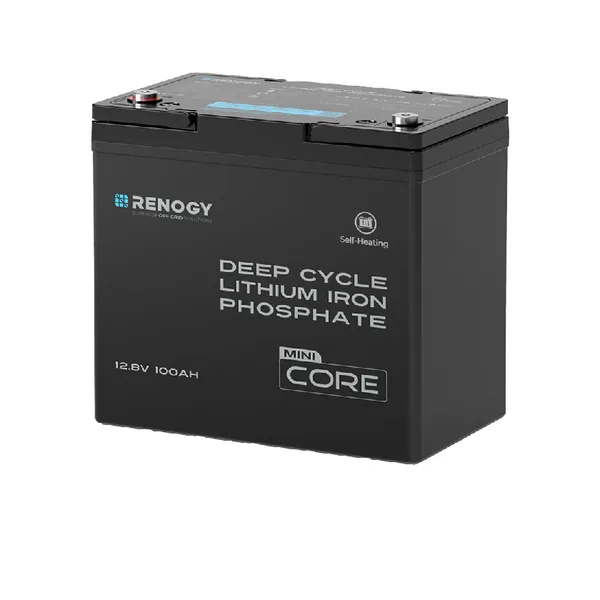 | Size: 9.02 x 5.43 x 8.39 in | Weight: 21.38 lb | Cycle rating: 5000 at 80% DOD | Charging below 32 F: Heats, charges to -22 F | Monitoring: Shunt needed, sold separately | Get yours on Amazon |
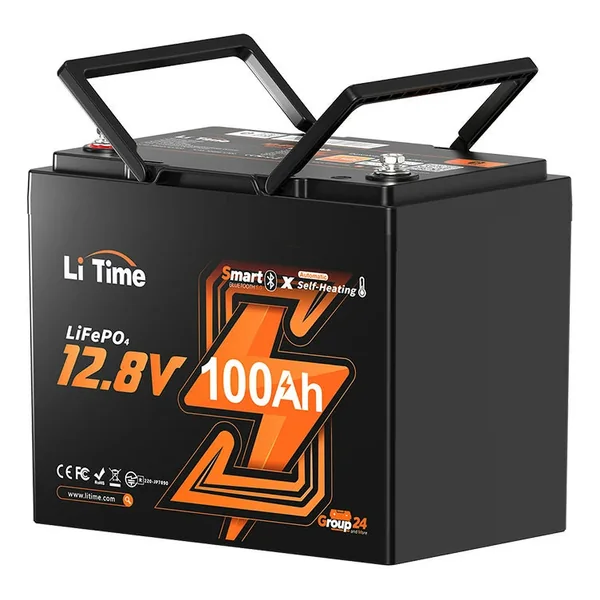 | Size: 10.24 x 6.61 x 8.27 in | Weight: 22.71 lb | Cycle rating: 4000 at 100% DOD, 6000 at 80% | Charging below 32 F: Heats, charges to -4 F | Monitoring: Bluetooth 5.0 app | Get yours on Amazon |
Both standard batteries list 12.8 V and 100 Ah, which is roughly 1,280 Wh by simple multiplication. LiTime prints that figure; Renogy's page does not. Both list a 100 A maximum continuous charge and discharge current. By volume the Renogy box is about 44% smaller (our arithmetic from the two size lists), yet it weighs only about a pound less.
1. Renogy Core Mini: the smaller box
Renogy Core Mini 12V 100Ah
The Renogy product page lists the Core Mini at 9.02 x 5.43 x 8.39 in and 21.8 lb. It has a 100 A BMS, a 300 A peak for 5 seconds, IP65 protection and a 5000-cycle rating at 80% depth of discharge, measured at 0.5C and 25 C. Renogy says you can wire up to 16 of them in series and parallel (4S4P) for 20.48 kWh.
The catch is monitoring. Renogy says plainly that the battery has no Bluetooth port. To see its state on a phone you add the Renogy 300A battery shunt, sold separately, and use the DC Home app. The warranty is 5 years, prorated. The low-temperature protection stops charging below 32 F (0 C) and the discharge limit is -4 F (-20 C).
On Amazon on 9 October 2026 the Core Mini listing showed In Stock with an Add to cart button, sold by the Renogy store (RenogyRego). It ranked #99 in 12V Batteries, behind the LiTime on that list, and has far fewer reviews: it is a newer listing.
2. LiTime Group 27: the app in the battery
LiTime 12V 100Ah Group 27
The LiTime product page lists the Group 27 at 12.09 x 6.81 x 8.86 in and 22.85 lb. It lists 1280 Wh, a 100 A BMS with a 500 A surge for 1 second, IP65, and Bluetooth 5.0 with the LiTime app for state of charge, current, voltage and temperature. The cycle rating is 4000 at 100% depth of discharge, 6000 at 80% and 15,000 at 60%. The warranty is 5 years. The page says to install it on the front, side or bottom, not on the back or top.
LiTime recommends a 20 A charge current and a charge voltage of 14.4 V, plus or minus 0.2 V. Charging switches off below 32 F (0 C) and comes back at 41 F (5 C). Its Amazon listing adds a warning: it is not suitable for starting engines, golf carts or jacks.
The independent test was done on the Group 24 version of this Bluetooth family, not the Group 27. Nick at Cleversolarpower measured 1,312 Wh (102.5 Ah) at a 20 A discharge, found the cells to be from Gotion, made in 2025, and saw the charge cut-offs at 0 C and 50 C work. His complaint was the app: it shows balance and BMS status but no individual cell voltages, and he said a premium-priced battery should show them. He called it a good battery, but not one he would buy for that reason. His video description carries purchase links and a discount code.
On Amazon on 9 October 2026 the Group 27 listing showed In Stock with an Add to cart button, sold by LiTime's own US store. It ranked #51 in 12V Batteries, with 100+ bought in the past month.
The cold is the catch

Renogy lists a charge range of 32 to 122 F (0 to 50 C) for the Core Mini, with a low-temperature cut-off that blocks charging below 32 F. LiTime lists the same 0 to 50 C and turns charging off below 32 F. This is normal: Battery University says lithium-ion batteries cannot be charged below freezing, because lithium plates onto the anode and the loss is permanent. Discharging still works down to -4 F (-20 C) on both.
So a frozen morning with sun on the panels does nothing for a standard lithium battery until it warms up. Our lithium vs AGM guide covers the other side of that trade: lead-acid charges in the cold, but it weighs more and gives you less usable capacity.
Heat is the other end. Both list 122 F (50 C) as the top of the charging range. Chenzo, who lived in a van in Spain and Portugal, says: "In Portugal it can be 40, 45 degrees. So the bus can get so hot." A 45 degree day is only 5 degrees below that 50 C charge limit.
Also worth a look: the self-heating versions
Each maker sells a self-heating version of the same battery. They cost more, and they are the ones to buy if a van will sit in freezing weather with the solar still working.
The two self-heating batteries
Renogy Core Mini DuoHeat 12V 100Ah
Renogy lists charging down to -22 F, 110 W heating pads, and ready-to-charge from -22 F in about 60 minutes. 21.38 lb, IP65, 5-year prorated warranty. No Bluetooth in the battery.
LiTime 12V 100Ah Group 24 Self-Heating
LiTime lists charging down to -4 F, heating from -4 to 41 F, 70 to 90 minutes from 14 F and 100 to 150 minutes from -4 F. It needs at least 10 A of charge current to heat. 22.71 lb, Bluetooth 5.0.
The independent evidence is for the Renogy one. In his test, Ray at Love Your RV & Boat put the DuoHeat Mini in a freezer at about -3 F overnight, connected a 40 A charger, and saw it reach about 36 A of charging after roughly 20 minutes. The heating pads drew about 110 W, which matches Renogy's rating. He then ran it at about 47 A for two hours and the voltage was still 12.4 V, which he said was as good as the other premium batteries he had tested the same way. His drawbacks: no Bluetooth app, and a battery that is glued and taped together and hard to repair. Renogy sent him the battery as a review sample, which he says in the video.
A word on fuses, from the road

Chenzo, founder of NomadsToolsLab
I lived in a van, a caravan and a trailer for seven years in Spain and Portugal, off grid, and I built everything inside myself. "Use fuses. I put the wrong fuse in, the wrong fuse size, and luckily it was too low, so it blew all the time. I put a new one in three, four times, and then I found out that my calculations were bad, that I had to put a 15 amp fuse in instead of a 5." That was my case, not a rule: your fuse depends on your cables and your loads. And watch plus and minus: "Somebody helped me to put the plugs on the cables from the sun panels and he did plus on minus and minus on plus." Be careful for fire.
Both batteries can deliver 100 A continuously, so a wrong fuse or a wrong cable is not a small mistake. Our camper van wiring guide walks through fuse blocks, cables and lights, and the Victron vs Renogy charge controller comparison covers the part that sits between the panels and either battery. If you are still planning the whole build, start with the cargo van conversion for beginners.
Which one to pick

A small bay under the seat or a teardrop trailer: the Renogy Core Mini, at about 44% less volume. A Group 27 compartment and a phone app: the LiTime Group 27, because the app is in the battery and needs no extra part. A full-time van that sits in the snow: a self-heating version of either, charged from a source that can supply at least 10 A. A weekend rig on a small budget: read the lithium vs AGM comparison first.
For charging, our power stations for van life and solar panels for a camper van guides cover the rest of the setup, and Bluetti vs EcoFlow compares the all-in-one alternative. If the battery will run a 12 V fridge, ICECO vs BougeRV compares two popular ones.
- Renogy Core Mini: 21.8 lb, 9.02 x 5.43 x 8.39 in, IP65, 5000 cycles at 80% DOD, no Bluetooth port, 5-year prorated warranty.
- LiTime Group 27: 22.85 lb, 12.09 x 6.81 x 8.86 in, IP65, Bluetooth 5.0, 4000 cycles at 100% DOD, 5-year warranty.
- Both list a charging range of 32 to 122 F (0 to 50 C). Self-heating versions charge in the cold.
- On 9 October 2026 both were in stock on Amazon with an Add to cart button.
Watch: a self-heating Renogy Core Mini under test
Video by Love Your RV & Boat on YouTube. Renogy supplied the battery as a review sample, which the channel says in the video.
Watch: a LiTime battery on the test bench
Video by Cleversolarpower by Nick on YouTube. This video tests the Group 24 version of the same Bluetooth family, and the video description carries purchase links and a discount code.

FAQ
Is Renogy or LiTime better for a camper van?
They are close. Renogy lists the smaller box (9.02 x 5.43 x 8.39 in, 21.8 lb) with no Bluetooth in the battery. LiTime lists a Group 27 box (22.85 lb) with Bluetooth 5.0 built in. Both list 100 Ah, a 100 A BMS, IP65 and a 5-year warranty.
Does the Renogy Core Mini have Bluetooth?
No. Renogy says it has no Bluetooth port. You can add the Renogy 300A battery shunt, sold separately, which sends data to the DC Home app.
Can I charge a Renogy or LiTime lithium battery below freezing?
Not the standard versions. Both stop charging below 32 F (0 C). The self-heating versions are built for it: Renogy lists charging down to -22 F, and LiTime lists -4 F for its self-heating Group 24.
How many cycles do Renogy and LiTime batteries last?
Renogy lists 5000 cycles at 80% depth of discharge. LiTime lists 4000 at 100%, 6000 at 80% and 15,000 at 60%. These are the makers' own ratings, measured under different conditions.
Can I use a LiTime battery to start an engine?
LiTime's Amazon listing says the Group 27 is not suitable for starting engines, golf carts or jacks. Use a starter battery or a jump starter for that.
Which is smaller, Renogy or LiTime?
The Renogy. By the sizes the makers list, its box has about 44% less volume than the LiTime Group 27, and it weighs about a pound less.
Affiliate disclosure. This post contains affiliate links. If you click and buy something, this site earns a small commission at no extra cost to you. Picks are based on published specs, independent tests and manufacturer information. As an Amazon Associate I earn from qualifying purchases. Read the full affiliate disclosure. Amazon and the Amazon logo are trademarks of Amazon.com, Inc. or its affiliates.
Your next step