

Lithium vs AGM Battery for a Camper Van: Which to Buy?
As an Amazon Associate I earn from qualifying purchases. Some links on this page earn us a small commission, at no extra cost to you. Full disclosure.
Lithium vs AGM battery for a camper van comes down to weight, usable energy, cycle life and cold. A Renogy 12 V 100 Ah AGM weighs 63.9 lb and lists 500 cycles at 50% depth of discharge. A LiTime 12 V 100 Ah lithium (LiFePO4) in Group 27 size weighs 22.85 lb and lists 4,000 cycles at 100%. We read the maker pages on 5 October 2026.

Quick answer
Checked on 5 October 2026. Choose lithium if the van is your home or you use it most of the year: the makers list far more cycles and the battery weighs roughly a third as much. Choose AGM if you use the van a few weekends a year and the budget is tight. Camping below freezing? Pick the self-heating lithium, or keep the battery inside the warm part of the van.
All picks, with a buy button each
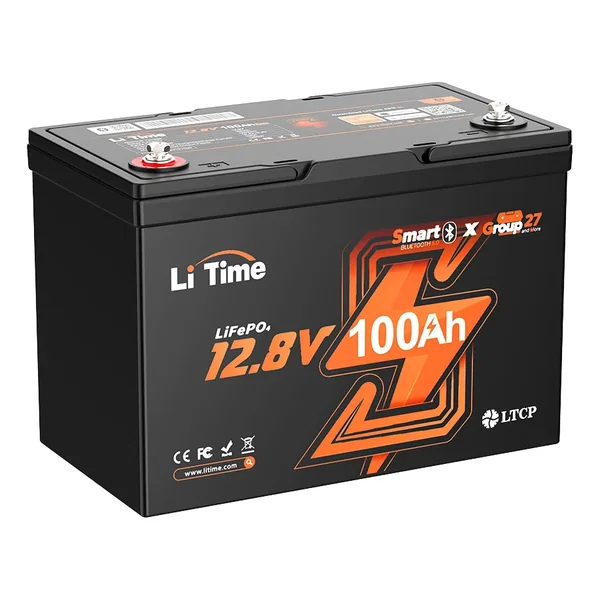
LiTime 12V 100Ah Group 27
Lists 22.85 lb, 4,000 cycles at 100% depth and Bluetooth. Charging stops below 32°F. Read more
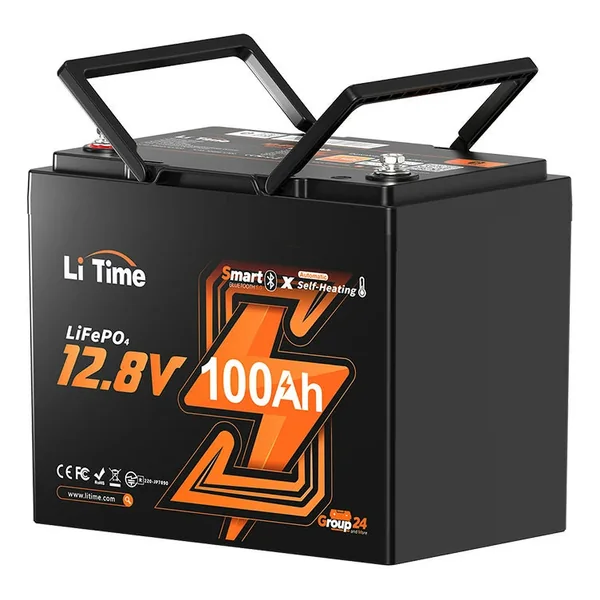
LiTime 12V 100Ah Self-Heating Group 24
Warms itself before charging when the battery is between -4°F and 41°F. Read more
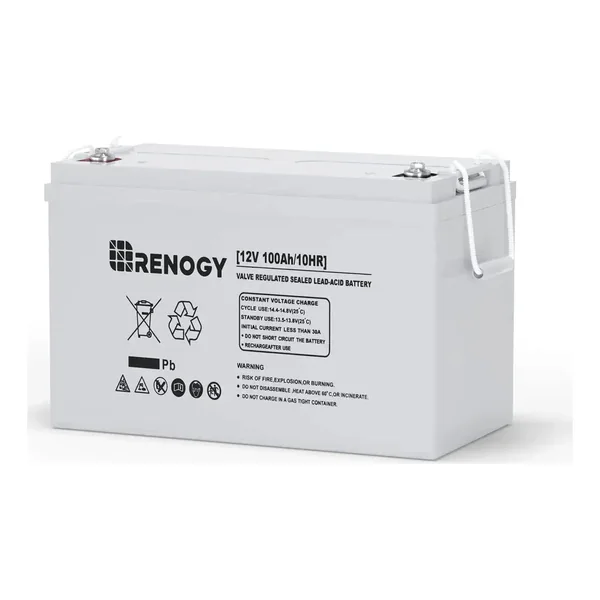
Renogy 12V 100Ah Deep Cycle AGM
Lists 63.9 lb and 500 cycles at 50% depth. Lower cost up front. Read more
How we compared them
The NomadsToolsLab team read the maker pages for all three batteries end to end on 5 October 2026 and checked each Amazon page with a US delivery address. All three show a buy button and are sold new.
What surprised us: the makers do not agree on the cold limit. LiTime's page says its battery stops charging below 32°F (0°C), while Battle Born says lithium batteries should not be charged below approximately 25°F unless they have internal heating. Renogy's AGM sheet lists the same 32°F lower charge limit as LiTime's lithium sheet. Where the two chemistries differ is what happens below that line. Battery University, the battery education site from Cadex, says no charge is permitted below freezing for lithium-ion and that lead acid is much more tolerant of cold charging. Builders at The Vansmith land on the same practical split in their March 2026 guide: lithium is the clear choice for frequent off-grid use, AGM suits occasional weekend users on a tight budget, and lithium needs a charger that is set up for lithium.
Every number in the table comes from the makers' own pages.

From the road: Use fuses. I put the wrong fuse in, the wrong fuse size, and luckily it was too low, so it blew all the time. I put a new one in three, four times, and then I found out that my calculations were bad.
Lithium vs AGM battery at a glance

| Pick | Type | Weight | Cycle life | Charging in the cold | Shop |
|---|---|---|---|---|---|
| Type: Lithium (LiFePO4) | Weight: 22.85 lb | Cycle life: 4,000 cycles at 100% depth | Charging in the cold: Stops below 32°F, resumes at 41°F | Get yours on Amazon |
| Type: Lithium (LiFePO4) | Weight: 22.71 lb (listing) | Cycle life: 4,000+ cycles at 100% depth | Charging in the cold: Heats from -4°F to 41°F, stops heating at 50°F | Get yours on Amazon |
| Type: AGM (lead acid) | Weight: 63.9 lb | Cycle life: 500 cycles at 50% depth | Charging in the cold: Charge range 32 to 122°F | Get yours on Amazon |
Both LiTime pages list 12.8 V, 100 Ah and 1,280 Wh. Renogy lists 100 Ah at 12 V, measured at the 10-hour rate to 10.5 V. The cycle counts are quoted at different depths of discharge, so compare the energy you can really draw, not only the label. We do that sum below.
1. LiTime 12V 100Ah Group 27: lithium
LiTime 12V 100Ah Group 27 LiFePO4

The LiTime 12V 100Ah Group 27 is a LiFePO4 battery. LiTime's page lists 12.8 V, 100 Ah, 1,280 Wh, 22.85 lb and a case of 12.13 x 6.69 x 8.31 in (Group 27 size) with an IP65 rating and a 100 A BMS. Cycle life is listed as 4,000 cycles at 100% depth of discharge, 6,000 at 80% and 15,000 at 60%. If you are choosing between two lithium batteries instead of lithium and lead-acid, our Renogy vs LiTime comparison sets the Renogy Core Mini against this LiTime.
The recommended charge voltage is 14.4 V plus or minus 0.2 V at 20 A. Low-temperature protection is on: charging switches off below 32°F (0°C) and comes back at 41°F (5°C), and discharge switches off below -4°F (-20°C). The Amazon listing we checked is sold by LiTime US and says the battery is not suitable for starting an engine.
2. LiTime self-heating: lithium for the cold
LiTime 12V 100Ah Self-Heating Group 24

The LiTime self-heating Group 24 adds two heating pads. LiTime says the heating starts when the battery temperature is between -4°F and 41°F and stops when it reaches 50°F. From 14°F it lists 70 to 90 minutes to heat up, and from -4°F 100 to 150 minutes. There are two modes: in the regular mode the charger does the heating when the charger current is 10 A or more, and in the energy-efficient mode the battery can add to it while its charge is above 20%.
The Amazon listing says it fits a Group 24 box, weighs 22.71 lb, has Bluetooth 5.0 and lists 4,000+ cycles at 100% depth. It is sold by LiTime US. The wait while it warms is the price of the feature: plan your solar and charging around it.
3. Renogy 12V 100Ah AGM
Renogy 12V 100Ah Deep Cycle AGM

Renogy lists the Renogy 12V 100Ah AGM at 100 Ah (10-hour rate to 10.5 V), 63.9 lb and 13.1 x 6.9 x 8.6 in. Cycle life is listed as 500 cycles at 50% depth of discharge, self-discharge below 3% per month at 77°F, and you can connect up to four in parallel. Maximum continuous charging current is 30 A, cycle charge voltage 14.4 to 14.8 V and float voltage 13.5 to 13.8 V.
The temperature table lists charging from 32 to 122°F and discharge from -4 to 140°F. The warranty is listed as 2 years, prorated. There is no Bluetooth and no communication port. The listing we checked is sold and shipped by Amazon.com.
Weight, usable energy and life

Weight first. Renogy lists 63.9 lb for the AGM and LiTime 22.85 lb for the Group 27 lithium, which is about 41 lb less. The Vansmith puts it as roughly half the weight for the same usable energy, because lithium is usually sized to 80 to 90% usable while AGM is sized to 50%.
Now life. Renogy lists 500 cycles at 50% depth, so each cycle delivers about 50 Ah: 500 x 50 Ah is 25,000 Ah over the listed life. LiTime lists 4,000 cycles at 100% depth, so 4,000 x 100 Ah is 400,000 Ah. That is our own sum from the makers' figures. The tests behind the numbers are not the same, so read it as a ratio and not as a promise. It does explain why builders say lithium wins on cost per cycle even though it costs more up front.
Cold weather: the rule that decides

Battle Born (page dated 4 May 2026) says lithium batteries can discharge down to approximately -4°F, but should not be charged below approximately 25°F unless they have internal heating, and that the BMS blocks charging outside safe limits. They also say they offer heated versions. LiTime's page for its standard 100 Ah battery says to charge only when the battery is above 32°F (0°C), that charging in freezing temperatures will damage the cells, and that on cold days the best practice is to bring the battery indoors to charge.
Battery University explains why: charging lithium-ion below freezing plates metallic lithium on the anode, which causes permanent loss of performance and safety. For lead acid it says the low-temperature charge rate is almost the same as normal, but the voltage must be adjusted and a frozen lead-acid battery is permanently damaged, so keep it fully charged in the cold. Renogy's own AGM sheet still lists 32°F as the lowest charge temperature, so follow it.
What we would check before buying for winter
- Does the battery list a charge temperature range, and is it a 32°F or a 25°F limit?
- Is there a heated model, and how long does it list to warm up from the temperature you camp in?
- Can the battery sit inside the heated space of the van, so it never gets that cold?
What your charger has to do

The Vansmith says lithium needs set charge voltage curves and often a DC-DC charger or alternator controller that works with lithium. LiTime lists 14.4 V plus or minus 0.2 V for its lithium; Renogy lists 14.4 to 14.8 V for cycle use and 13.5 to 13.8 V for float on its AGM. Those are different profiles, so a controller set for one is not automatically right for the other. If you are choosing a solar controller, our Victron vs Renogy charge controller comparison lists what each controller supports, and the camper van solar panel guide covers the panels.
Fuse it, whatever you buy
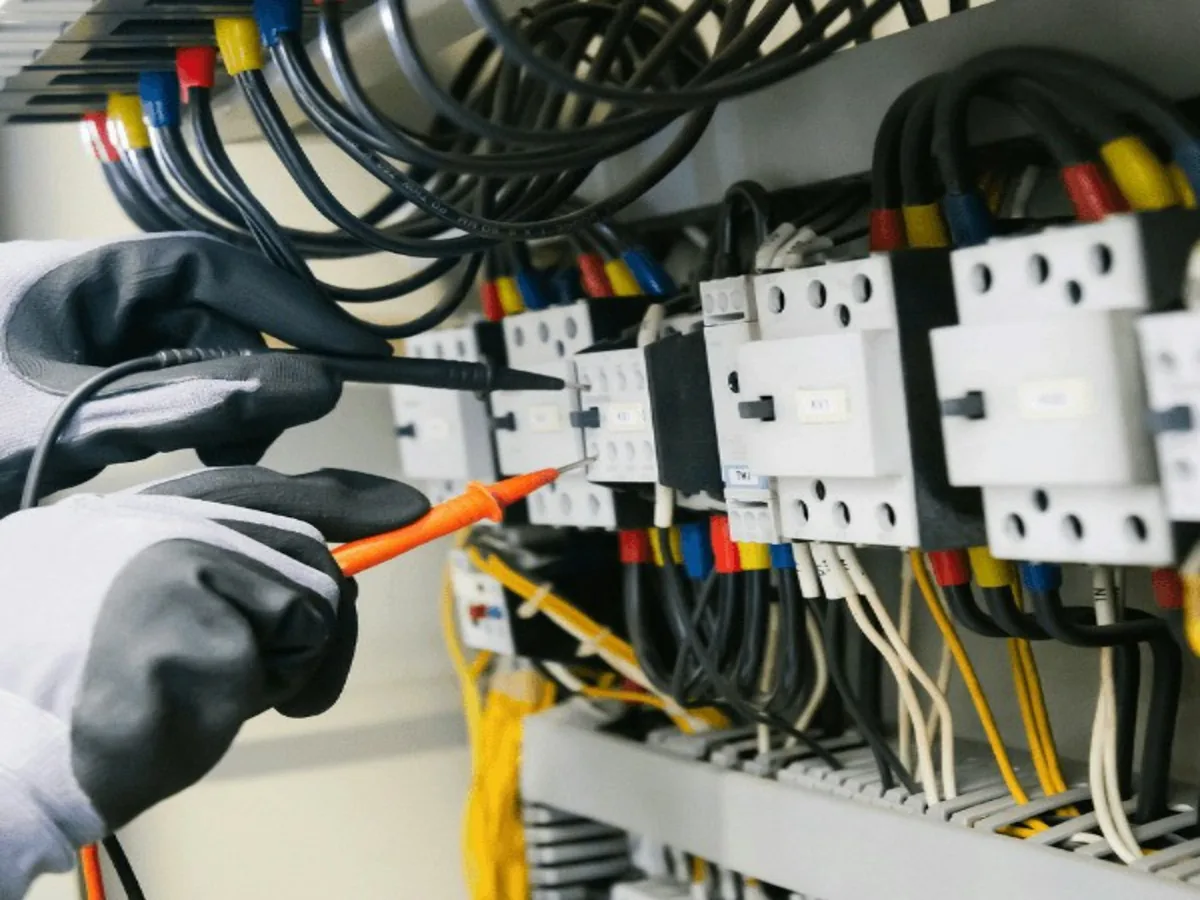
Chenzo built his own van and learned this the hard way. On fuses: "So you have to be careful for fire, really be careful, and please use the right fuses. So important, that can save your life. You don't want to be in a burning car or a burning caravan." The right size depends on your cable and load, so calculate it. Our how to wire a camper van guide shows the fuse block, and rats chewing wires covers the other thing that can ruin a battery cable.

Chenzo, founder of NomadsToolsLab
I lived in a van and a caravan for seven years in Spain and Portugal, off grid. I built everything inside the van myself.
Which one to pick

Pick the LiTime Group 27 if
- you live in the van or use it most of the year
- you want a lighter battery and an app to watch it
- the battery stays inside the van or you mostly camp above freezing
Pick the LiTime self-heating if
- you camp where nights go below freezing and you want to keep charging
- you can accept a warm-up wait before charging starts
Pick the Renogy AGM if
- you use the van a few weekends a year and the budget is tight
- you want a simple sealed battery with no electronics
- you can live with the weight and with using half the rating
Running a bigger system with a portable station instead of a fixed bank? Our power station guide for van life and the Bluetti vs EcoFlow comparison cover that route.
- Renogy AGM 100 Ah lists 63.9 lb and 500 cycles at 50% depth; LiTime Group 27 lithium lists 22.85 lb and 4,000 cycles at 100%.
- Lithium: charging stops around freezing (LiTime 32°F, Battle Born about 25°F unless heated). Pick a heated model or keep it warm.
- AGM: Renogy lists a 32 to 122°F charge range, so it is not a cold-weather cure either.
- Set every charge source to the right profile: lithium and AGM voltages differ.
- Fuse the battery and check the polarity, whatever the chemistry.
Where to go next

Planning the whole build? Read cargo van conversion for beginners and how to wire a camper van. For the panels see solar panels for a camper van, BougeRV vs Renogy 200W panels and MPPT vs PWM charge controllers. Prefer a power station? See Bluetti vs EcoFlow.
FAQ
Is lithium or AGM better for a camper van?
Lithium lists far more cycles at deeper discharge and weighs roughly a third as much: LiTime lists 22.85 lb and 4,000 cycles at 100% depth, Renogy lists 63.9 lb and 500 cycles at 50%. AGM costs less up front, so it suits occasional use on a tight budget.
Can lithium batteries be charged below freezing?
Not without help. LiTime says charging stops below 32°F (0°C), Battle Born says not below approximately 25°F unless heated, and Battery University says no charge below freezing for lithium-ion. A self-heating model or a warm spot inside solves it.
How much of a 100 Ah AGM battery is usable?
Renogy lists the cycle life of its 100 Ah AGM at 50% depth of discharge, 500 cycles. Plan around about half the rating. LiTime lists 4,000 cycles for its lithium at 100% depth.
Do I need a different charger for lithium?
Check every charge source. The Vansmith says lithium needs set charge voltage curves and often a DC-DC charger or alternator controller made for lithium.
Can these batteries start the engine?
No. The LiTime listing says its battery is not suitable for starting batteries, and both are deep cycle batteries made to run the living area of the van.
Affiliate disclosure. This post contains affiliate links. If you click and buy something, this site earns a small commission at no extra cost to you. Picks are based on published specs, independent tests and manufacturer information. As an Amazon Associate I earn from qualifying purchases. Read the full affiliate disclosure. Amazon and the Amazon logo are trademarks of Amazon.com, Inc. or its affiliates.
Your next step